Grand Ayatollah Al-Najafi’s Office Convenes 12th Annual Delegates Conference in Holy Najaf
26/9/2026
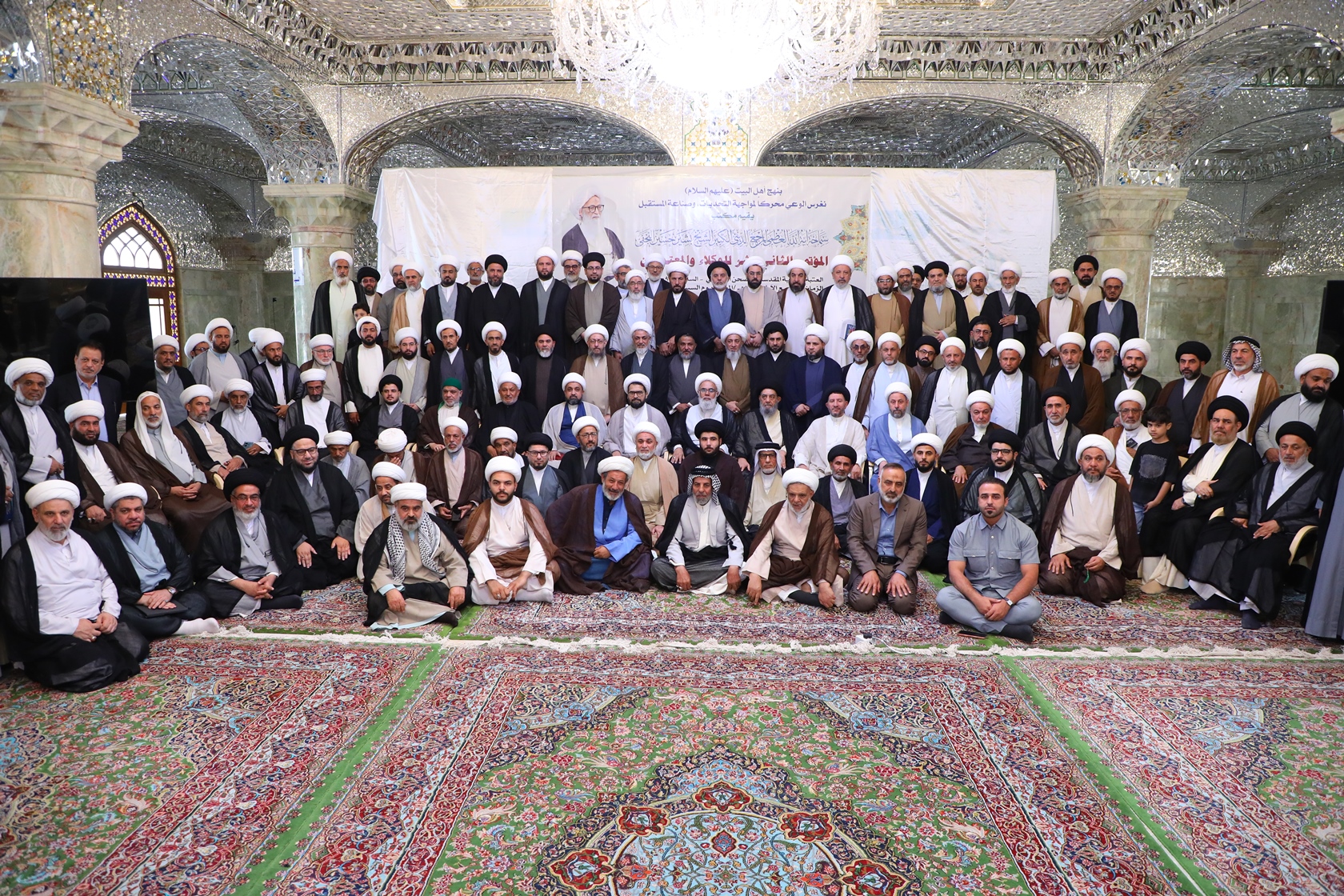
Scholars Gather at Imam Ali Shrine to Address Regional
Challenges, Youth Engagement, and Preparations for the Annual Fatimiya
Procession
Najaf Al-Ashraf — The Department of Representatives and
Delegates at the office of His Eminence, the Religious Authority Grand
Ayatollah Sheikh Bashir Hussain Al-Najafi (may Allah prolong his life ), held
its 12th Annual Conference for Representatives and Delegates in the holy
governorate of Najaf Al-Ashraf. The event took place at the Courtyard of Lady
Fatima Al-Zahra (peace be upon her) inside the Holy Shrine of Imam Ali, in the
presence of the representative of Grand Ayatollah Al-Najafi and Director of his
Central Office in Najaf Al-Ashraf, His Eminence Sheikh Ali Al-Najafi.
The conference was held under the banner: "Guided
by the Path of Ahl al-Bayt (peace be upon them), We Cultivate Awareness as a
Drive to Face Challenges and Shape the Future." It witnessed the
participation of several representatives and delegates of Grand Ayatollah
Al-Najafi arriving from various cities and governorates across Iraq, spanning
from Mosul in the north to Basra in the south.
The convening of this conference comes within the
framework of ongoing coordination between the Central Office and the
representatives and delegates, monitoring academic, missionary, and social
issues pertinent to the Iraqi reality. Additionally, it aims to prepare for
commemorating the anniversary of the martyrdom of the Pure Truthful Lady,
Fatima Al-Zahra (peace be upon her) according to the second narration, and
organizing the annual symbolic Fatimiya procession that sets off to
express devotion and adherence to the blessed path of Ahl al-Bayt (peace be
upon them).
Emphasizing Direct Communication and Reading the
Current Reality
His Eminence Sheikh Ali Al-Najafi, the representative
of Grand Ayatollah Al-Najafi and Director of his Central Office in Najaf
Al-Ashraf, delivered a speech emphasizing the importance of direct meetings and
continuous consultation between the Central Office, representatives, and
scholars undertaking missionary work. He noted that this reinforces unity of
vision, raises coordination, and contributes to dealing consciously with new
developments and challenges.
His Eminence pointed to the epistemological principle
reported from Imam Al-Sadiq (peace be upon him): "He who is knowledgeable
of his time will not be overwhelmed by ambiguities." He stressed the
necessity of understanding the present reality and its transformations, linking
missionary work to the actual needs of society alongside its intellectual,
cultural, and social changes.
Discussions affirmed that representatives and delegates
do not merely perform administrative representation; rather, they serve as the
field-level face and direct extension of the Religious Authority’s message
across various regions. This places upon them the responsibility of conveying
guidance, consolidating moral values, and fostering religious and social
awareness among believers.
The addresses also recalled the role played by the
Religious Authority during the era of the Major Occultation as a spiritual
canopy and social umbrella protecting the cohesion and unity of the nation.
Speakers paid tribute to the painful loss of several prominent scholarly
figures and Grand Ayatoyllahs, highlighting the deep impact and vacuum their
passing left in the Islamic arena—an aspect that doubles the responsibility of
the scholarly and missionary community to continue serving and fill this void
with high resolve.
Reading Regional Developments and Economic Realities
The conference analyzed a set of regional and domestic
developments in light of the rapid transformations and complex geopolitical
challenges the region is witnessing, particularly since the onset of major
events, field developments, and the accompanying confrontations and targeting
of prominent figures and leaders. Their Eminences and Virtuous Scholars also
deliberated on the current economic and political situation affecting the
country.
Social Challenges and Strengthening Discourse Directed
at Youth
The conference devoted significant attention to the
social, intellectual, and cultural challenges facing society, particularly
regarding religious discourse amidst the shock of digital media and rapid
cultural shifts.
Sheikh Ali Al-Najafi highlighted the importance of
modernizing the tools of religious discourse to keep pace with new
developments. He noted that the widespread proliferation of content creators across
modern media places a double responsibility on clerics and missionaries to act
as fathers, educators, and field role models who can maintain a positive
presence and exert a constructive influence on society.
Attendees stressed the importance of tapping into the
extensive energy of youth within the Husaini processions and assemblies,
viewing them as a genuine educational and ideological asset that connects a
broad segment of youth to the path of Ahl al-Bayt (peace be upon them) and
fortifies them against intellectual and cultural challenges.
Recommendations called for strengthening direct,
ongoing communication with authentic Iraqi tribes and their leaders to solidify
religious concepts and counter any attempts to prioritize customs that
contradict Islam. The conference emphasized that closeness to Almighty God and
elevation in ranks of service are achieved through sincere field performance in
serving and protecting society.
Protecting the Family and Organizing Seminary (Hawza)
Affairs
The conference highlighted the status of Muslim women,
reviewing the intense intellectual and media campaigns targeting the structure
and stability of the family in recent years under various pretexts.
Attendees emphasized that women are a pivotal element
in building the family and society. They stressed the need to develop guiding
discourse directed toward women, adopting a fatherly and educational approach
that preserves the dignity of Muslim women, enhances their role in safeguarding
Islamic values within the home and community, and shields them from falling
prey to intellectual and cultural deception.
In the same context, the conference affirmed the
necessity of organizing seminary (Hawza) work and maintaining a methodical
distinction between academic ranks to ensure the rigor of religious
presentation in the public sphere, while continuing to support model seminaries
and traditional schools across various governorates.
Sheikh Adel Al-Zargani: Facing Challenges Requires
Thought, Knowledge, Awareness, and Wisdom
During the proceedings, Sheikh Adel Al-Zargani, Head of
the Department of Representatives and Delegates, delivered an address on the
current era and the growing responsibilities placed upon clerics, stating:
"We
are living in a period of accelerating transformations and intertwined
challenges. A cleric's responsibility is no longer limited to stating religious
rulings or resolving individual issues; it has broadened significantly because
he stands before a society torn by intellectual questions, political pressures,
and rapid cultural and value shifts.
Among the most prominent challenges facing society and
religion today are intellectual, political, social, and cultural ones—some are
visible and easily diagnosed, while others quietly slip into human
consciousness until they become part of a person's mindset and outlook toward
religion, humanity, and life."
His Eminence clarified that confronting these
challenges cannot be done through mere reactions or traditional discourse that
diagnoses problems without offering a constructive vision. Rather, it requires
thought, knowledge, awareness, patience, steadfastness, wisdom, and the ability
to comprehend reality before judging it.
He added:
"A
cleric in this era should not merely be a transmitter of information, but a
builder of awareness, a guardian of values, and someone capable of reading
transformations and addressing human minds in a language they understand and an
innate nature (Fitrah) they trust."
He explained that countering intellectual deviation is
achieved not by excluding thought, but by producing deeper thought; countering
doubt is done not by fearing questions, but by possessing the capability to
answer them; and confronting extremism is achieved by demonstrating Islam in
its intellectual, moral, and humanitarian reality.
He also emphasized that meeting social and political
challenges requires an awareness of reality, an understanding of its
complexities, and a responsible presence by clerics in serving society and
protecting its stability and values.
At the conclusion of his address, Sheikh Al-Zargani
prayed to Almighty Allah to grant everyone success in carrying this
responsibility, to live up to the expectations of the Religious Authority, and
to grant them spiritual insight, awareness of reality, wisdom in dealing with
people, and steadfastness upon the truth.
Proposals, Recommendations, and Preparations for the
Fatimiya Procession
The conference witnessed various proposals presented by
scholarly figures regarding organizational and missionary work to raise the
level of coordination between the Central Office and representatives across all
governorates.
The conference noted the necessity of full preparation
to participate in the procession commemorating the martyrdom of Lady Fatima
Al-Zahra (peace be upon her) according to the second narration. Grand Ayatollah
Al-Najafi (may Allah prolong his life ) personally participates in this annual
procession, which sets off from the Holy Office toward the Holy Shrine of the
Commander of the Faithful, Imam Ali ibn Abi Talib (peace be upon him).
The conference concluded by reaffirming the importance of continuing missionary, academic, and social efforts, strengthening engagement with all segments of society, and maintaining field readiness for religious occasions to consolidate religious awareness and embody the responsibility of delegates in serving the Iraqi people.